
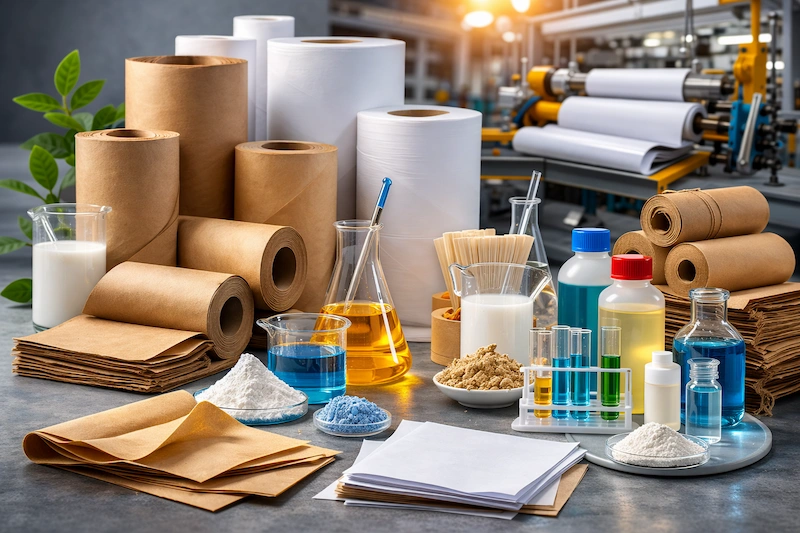
Precision Paper Engineering
Optimizing Mill Efficiency from Pulper to Reel.
Creativity Chemical Solution delivers modified starches, sizing chemicals, and process aids designed to combat rising energy costs and raw material volatility in paper mills.
Schedule Mill Trial
Wet End Additives
Building internal fiber-to-fiber bonding strength at the source for higher recycling rates and superior board quality.
The primary internal strength additive. When added to the pulp furnish, it bonds to fibers during pressing and drying, dramatically improving Burst Factor (BF) and tensile strength in recycled paper boards.
Positively charged starch that electrostatically bonds to negatively charged fibers, fillers, and fines. Acts as an internal retention aid, reducing loss of expensive fillers to the white water loop.
Applied between plies during the board-making process to bond individual layers. Critical for multi-ply Duplex and Triplex boards where ply delamination during converting is a major defect.

Surface Sizing & Coating
Perfecting printability, ink holdout, and surface strength for writing, printing, and specialty papers.
Chemically oxidized to achieve very low viscosity at high solid concentrations — penetrates the paper surface to form a dense, hydrophobic film that seals the sheet against ink feathering.
Fluorescent whitening agents that absorb UV light and re-emit it as visible blue light, increasing the perceived whiteness and brightness of the paper beyond 100% ISO.
Alkyl Ketene Dimer (AKD) and Alkenyl Succinic Anhydride (ASA) internal sizing agents that react with cellulose fibers to create a permanent hydrophobic barrier within the sheet.

Process Aids & Water Treatment
Maintaining machine runnability, white water cleanliness, and efficient effluent treatment.
Microbiological contamination in the white water loop creates slime deposits that cause sheet breaks, holes, and odor. Our oxidative and non-oxidative biocides keep the system clean.
Silicone and mineral oil-based defoamers that instantly collapse foam in the headbox, saveall, and stock preparation — preventing sheet quality defects and overflow losses.
Inorganic coagulants and polyelectrolyte flocculants for efficient clarification of raw process water and effluent treatment plant (ETP) operation.
Frequently Asked Questions
Answers to the questions our clients ask most.
What is the difference between Oxidized and Native Starch for paper?
Oxidized starch has a much lower viscosity at the same solid concentration, allowing deeper penetration into the paper surface at the size press. Native starch has higher viscosity and is used for internal wet-end strength addition. Both are critical — they serve different functions in the mill.
Can your starches be used with 100% recycled fiber?
Yes, in fact our Native Tapioca Starch was specifically optimized for high-recycled-content furnishes. Recycled fibers have lower bonding potential, and our starch compensates by building the fiber network.
What is the shelf life of Bleaching Powder / Sodium Hypochlorite?
These are reactive oxidizing agents. Bleaching Powder should be used within 3-4 months. Sodium Hypochlorite in liquid form degrades faster — within 1-2 months. We recommend ordering in quantities matched to your monthly consumption.
Do you provide on-site technical support for dosage optimization?
Yes. Our mill technologists visit customer sites to run trials, optimize dosage levels, and measure performance improvements. This service is included for customers with supply contracts.
Partner with Creativity Chemical
Solution Today.
Join 500+ manufacturers across India who rely on our products to deliver consistent quality. From a single sample to a JIT bulk-supply contract — our team is ready.