
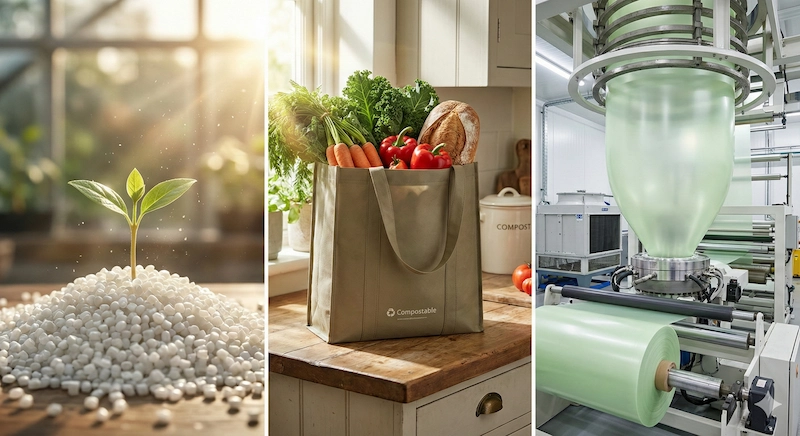
The Future is Bio-Based:High-Performance
Sustainable Polymers That Rival Traditional Plastics.
Creativity Chemical Solution bridges environmental responsibility and industrial performance. Our Thermoplastic Starch (TPS) and Bio-Polymer Compounds process on your existing machinery while meeting global compostability standards.
Request Pilot Kit
Bio-Based Starch Resins
Modifying natural starches to behave like thermoplastics — compostable, processable, and performance-matched to conventional plastics.
Thermoplastic starch derived from cassava tubers. High amylopectin content delivers excellent elongation and flexibility — ideal for flexible packaging films and single-use bags.
Thermoplastic starch from maize with high amylose content. Forms a rigid, heat-stable material when blended with PBAT — ideal for single-use food service items.
Pre-compounded blends of our TPS with PBAT (flexible) or PLA (rigid) for customers who need certified compostable performance with optimized mechanical properties.

Process Aids & Modifiers
Ensuring smooth machine operation, reduced cycle times, and compatibility of bio-based compounds with existing processing lines.
A thermally converted starch that acts as a processing flow modifier and plasticizer in TPS compounds. Reduces melt viscosity for smoother extrusion at lower temperatures.
An ionic starch derivative that improves compatibility between hydrophilic starch and hydrophobic polyesters (PBAT, PLA) — acting as a surfactant at the interface between the two polymer phases.
Food-grade glycerol used as a primary plasticizer for thermoplastic starch. Disrupts starch crystallinity, allowing it to flow and be processed like a thermoplastic above the glass transition temperature.
Frequently Asked Questions
Answers to the questions our clients ask most.
Do I need special machinery to process your bio-polymer compounds?
No. Our TPS compounds are designed as drop-in replacements. They process on standard blown film extruders, cast film lines, and injection moulding machines used for LDPE/PP — requiring only minor temperature adjustments. We provide a processing guide with every product.
What is the degradation time in home composting vs. industrial composting?
In certified industrial composting (58-60°C, >60% humidity), our films break down in 30-90 days. Home composting takes significantly longer — typically 6-12 months depending on conditions. Our products are certified for industrial composting. For home compostable certification, we offer specific formulations.
Are the bio-polymer compounds food safe?
Yes. Our compounds are made from food-grade starch sources (tapioca and maize) and food-grade plasticizers. They meet FSSAI, EU food contact regulations (Regulation EC 10/2011), and FDA standards for food contact applications.
How does cost compare to conventional LDPE?
Our TPS compounds are currently priced 20-30% higher than virgin LDPE. However, when factoring in plastic tax compliance (EPR), reduced packaging waste fees, and premium brand positioning, the total cost of ownership is competitive. Our prices are 20% lower than imported certified bio-polymers.
Partner with Creativity Chemical
Solution Today.
Join 500+ manufacturers across India who rely on our products to deliver consistent quality. From a single sample to a JIT bulk-supply contract — our team is ready.