Industrial chemicals manufacturing

Essential Industrial Chemistry:Acids, Alkalis & Enzymes

Reliable Wholesale Supply for Process Industries Across India.

Creativity Chemical Solution is a trusted wholesaler of high-purity industrial chemicals — from HCl and Caustic Soda to bio-catalysts and disinfectants. Your supply chain continuity is our priority.

Get Bulk Quote

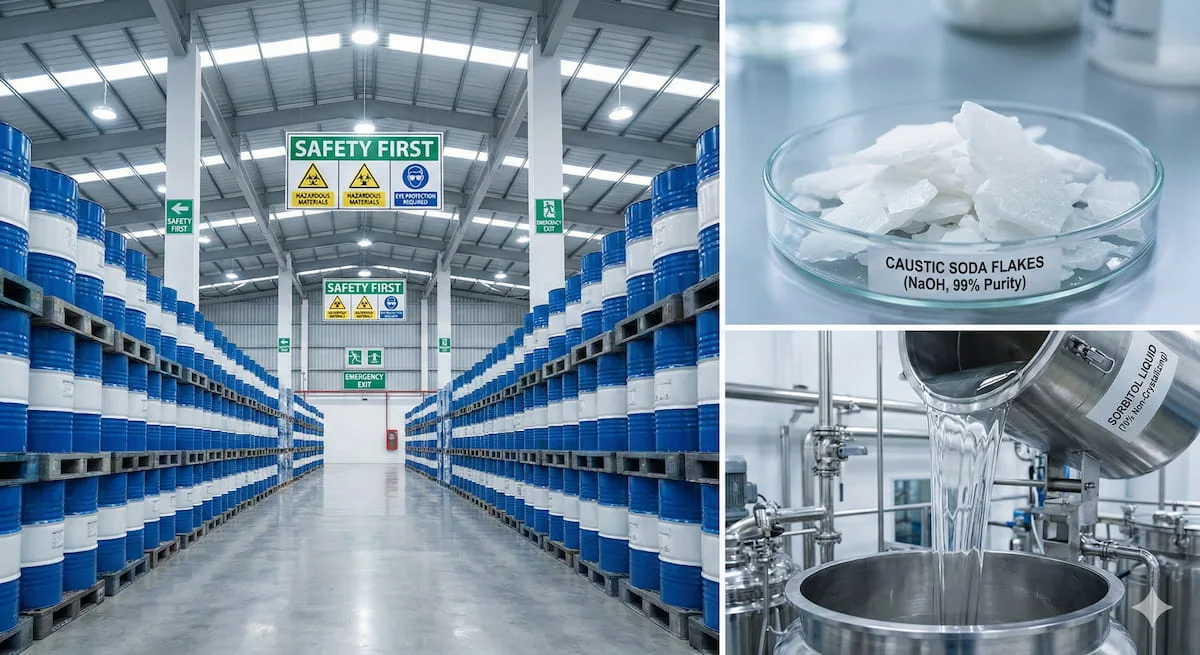
Industrial chemical storage

Acids & Alkalis

Fundamental pH regulators and reactants for textile processing, effluent treatment, water softening, and chemical manufacturing.

Hydrochloric Acid (HCl 30-33%)Industrial Grade

A strong mineral acid widely used for steel pickling, pH control in ETPs, textile desizing, and chemical synthesis. Supplied in HDPE carboys or road tankers.

Steel & Metal Pickling: Removes iron oxide scale from steel surfaces before galvanizing, coating, or further fabrication.
ETP pH Control: The most cost-effective acid for neutralizing alkaline effluents in textile and dyeing ETPs before discharge.
Textile Desizing: Acid desizing removes starch and PVA sizing from woven fabrics before dyeing — at controlled concentrations to prevent fiber damage.
Caustic Soda (NaOH)Flakes & Liquid

Sodium hydroxide in 98% flakes and 50% liquid solution. Essential for paper pulping, textile mercerization, soap manufacture, and ETP pH adjustment.

Textile Mercerization: 18-25% NaOH solution causes cotton fiber swelling and reorganization — dramatically increasing dye uptake, luster, and strength.
Paper Pulping: Kraft process uses caustic soda to dissolve lignin and extract cellulose fibers from wood chips.
ETP Neutralization: Neutralizes acidic effluents from dyeing and pickling operations before biological treatment.
Calcium Hydroxide (Lime)90%+ Purity

Hydrated lime used for water softening, leather processing, and as a low-cost alkali in effluent treatment and road construction.

Water Softening: Lime-soda softening process removes temporary hardness (calcium and magnesium bicarbonates) from process water.
Leather Liming: Swells hides and removes hair in the beamhouse operation of tanneries — essential for leather processing.
ETP Sludge Stabilization: Raises pH of sludge to kill pathogens before land application — inexpensive and effective.
Calcium Chloride77% / 94% Flakes

A highly soluble salt with exceptional desiccant and brine properties. Used in drilling fluids, food processing, concrete acceleration, and road dust suppression.
Drilling Fluid: High-density calcium chloride brines are used as completion fluids and packer fluids in oil and gas wells.
Concrete Acceleration: At 1-2% dosage, accelerates cement hydration — reducing setting time and enabling faster form stripping in cold weather.
Dust Suppression: Applied on unpaved roads and mine haul roads — hygroscopic nature keeps road surface damp and dust-free.
Chemical bleaching process

Bleaching & Oxidizing Agents

Powerful oxidizing agents for textile bleaching, water treatment, disinfection, and chemical synthesis.

Hydrogen Peroxide (H2O2 50%)Eco Bleach

A clean, eco-friendly oxidizing bleach that generates only water as a by-product. The preferred bleaching agent for cotton, paper, and food-grade applications where residue-free treatment is critical.

Cotton Bleaching: At 3-5 g/L in alkali conditions, achieves excellent whiteness without damaging cellulose — far less fiber damage than hypochlorite bleaching.
Paper Pulp Brightening: Peroxide brightening (P-stage) in the ECF bleaching sequence — chlorine-free and effluent-friendly.
ETP Odor Control: Oxidizes H2S and organic sulfur compounds in effluent streams — eliminating odor without chlorine residues.
Potassium Permanganate99% Purity

A powerful oxidizing agent with broad applications in denim distress finishing, water treatment, and organic synthesis.

Denim Distress Finish: Spray application on denim creates authentic vintage distress patterns by selectively oxidizing indigo dye — the most popular denim finishing technique.
Water Purification: Oxidizes iron, manganese, and hydrogen sulfide in borehole and groundwater — producing insoluble precipitates that are filtered out.
Odor Control: Used in wastewater treatment and food processing facilities to oxidize odorous organic compounds.
Sodium Hypochlorite (NaOCl)10-12% Active Cl

Liquid bleach used for textile bleaching, surface disinfection, and municipal water treatment. Cost-effective and widely available.
Textile Bleaching: Rapid, low-cost bleaching for cotton knits and wovens — requires careful pH and temperature control to prevent over-bleaching and fiber damage.
Surface Disinfection: Hospital-grade disinfection of floors, equipment, and surfaces in food processing and healthcare facilities.
Water Chlorination: Municipal and industrial water treatment for bacteriological safety compliance.
Industrial enzyme application

Industrial Enzymes

Bio-catalysts that enable cleaner, greener processing — replacing harsh chemicals with targeted enzymatic action.

Amylase (Desizing Enzyme)Starch Removal

Thermostable alpha-amylase for enzymatic desizing of starch-sized woven fabrics. Completely and specifically removes starch sizing without any risk of fiber damage.

Fiber-Safe Desizing: Unlike acid or oxidative desizing, enzymes act specifically on starch molecules — no risk of cellulose degradation and strength loss.
Low Temperature: Thermostable grades work at 55-65°C — lower temperature than oxidative methods, saving heat energy.
Wastewater Reduction: Enzymatic desizing produces lower COD/BOD effluent compared to acid or alkali desizing — reducing ETP load.
Cellulase (Bio-Polishing)Fuzz Removal

Cellulase enzyme for bio-polishing of cotton fabrics — removes surface fuzz and pilling to create a smooth, peach-skin surface and improve color vibrancy.

Surface Fuzz Removal: Cellulase cuts protruding microfibrils at the fabric surface — eliminating pilling tendency and giving a premium smooth hand-feel.
Color Brightness: Removing fuzz dramatically improves color depth and vibrancy — producing brighter, more saturated colors in dyed fabrics.
Stone-Wash Effect: When used with pumice stones or in the absence of stones, produces the classic denim stone-wash appearance enzymatically.
Catalase (Peroxide Killer)After Bleaching

Catalase enzyme rapidly decomposes residual hydrogen peroxide in fabric after bleaching — eliminating the need for water washing stages before dyeing.

Eliminates Rinse Step: A 15-minute catalase treatment completely destroys residual H2O2 — saving 3-4 water washing stages and significant water and energy costs.
Dyeing Compatibility: Residual peroxide destroys reactive dye — catalase ensures clean, bright, reproducible dyeing without shade variation.
Cold Enzymatic Bleaching: Enables an integrated cold peroxide bleaching + catalase + dyeing sequence in a single bath at low temperatures.
FAQ

Frequently Asked Questions

Answers to the questions our clients ask most.

Q

What safety measures are required for handling HCl?

A

HCl is highly corrosive and releases acidic fumes. Proper PPE (acid-resistant gloves, face shield, chemical apron) is mandatory. Storage requires HDPE or FRP tanks in ventilated areas, segregated from alkalis and oxidizers. We provide MSDS with every shipment and can advise on safe handling protocols.

Q

What are the benefits of enzymes over conventional chemicals?

A

Enzymes offer several advantages: they work at lower temperatures (saving energy), are specific in their action (no unintended side reactions), produce lower effluent load (lower COD/BOD), and are biodegradable themselves. The main consideration is that enzymes are more expensive per kg but are used at very low concentrations (1-5 g/L), making the total cost comparable or lower.

Q

Do you supply Hydrogen Peroxide in bulk tankers?

A

Yes, we supply H2O2 in HDPE carboys (30 kg), IBC totes (1000 L), and bulk tanker loads for large textile mills. Tanker supply requires compatible stainless steel or HDPE receiving tanks. We can advise on storage requirements.

Q

Can Caustic Soda (liquid) and Caustic Soda (flakes) be used interchangeably?

A

Yes, for most applications they are interchangeable — just adjust for the solid content difference (50% liquid vs 98% flakes). Liquid is more convenient for continuous dosing systems. Flakes are preferred where precise dosing by weight is needed or where storage space is limited. We supply both grades.

Partner with Us

Partner with Creativity Chemical
Solution Today.

Join 500+ manufacturers across India who rely on our products to deliver consistent quality. From a single sample to a JIT bulk-supply contract — our team is ready.